You’re probably not after a workout so much as the life around it: the hilly streets of Lisbon, eighteen holes on Saturday, lifting a carry-on into the overhead bin without asking for help, getting down on the floor with the grandkids and back up again without a second thought. The right trainer protects all of that, and the wrong one can sideline you with a sore shoulder for three months. Here’s how to tell the difference before you spend a dollar.
What certification should a personal trainer have?
Short answer: a nationally accredited certification such as ACE, NASM, ACSM or NSCA. These are accredited by the NCCA, the independent standard for fitness credentials, and you can verify most of them online in about a minute.
These programs test a trainer on anatomy, safe technique and how to adapt exercise for different ages and health conditions. That’s the minimum.
A certification is only the starting point. A trainer can pass the exam at 22 and never have coached anyone with a new hip. For clients over 50, the better questions are:
- How many people in my age range have you coached, and for how long?
- Have you worked with arthritis, joint replacements, osteoporosis or blood pressure medication?
Real experience with bodies like yours matters more than a long string of letters after a name.
What should happen in the first session?
Short answer: mostly questions, then a few simple movement tests. You should not end up gasping on the floor.
A good trainer wants your story first: past injuries and surgeries, medications, how you sleep and what a normal week looks like. Most of all, they want to know what you’re training for. “Get in shape” is vague. “Walk the Camino next spring” or “stop feeling wobbly on the stairs” is something a coach can build a plan around.
Then they’ll watch you move. Expect things like:
- Standing up from a chair without using your hands
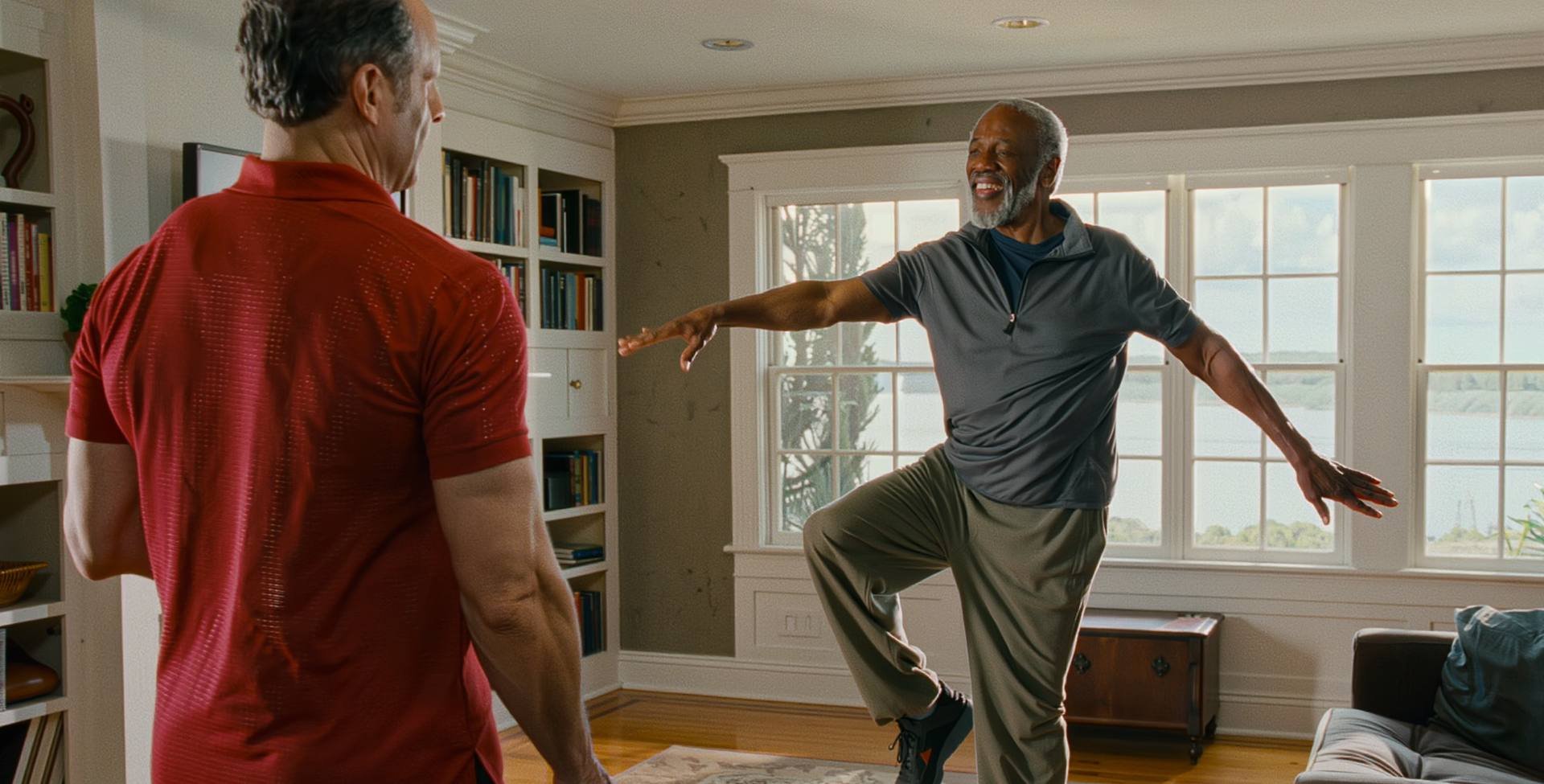
- Balancing on one foot
- Stepping up onto a low box
- Reaching overhead or turning to look behind you
These look simple, and they tell a skilled coach more about your strength, balance and joints than any punishing circuit could. A good first session ends with you knowing more about your own body than when you walked in.
How should a trainer adjust for joints, injuries and medications?
Short answer: every exercise has an easier and a harder version, and a good trainer moves between them quietly, without making you feel like a problem.
If a squat bothers your knee, they might shorten the range, put a box behind you to sit back to, or switch to a step-up. If your shoulder complains when you press overhead, they’ll find an angle that doesn’t hurt, so you get the same benefit without the pain.
The phrase you want to hear often is “Tell me how that feels.” Know the difference between normal and a reason to change the plan:
- Normal: tired muscles during the set, mild soreness for a day or two, breathing harder than usual.
- Change the plan: sharp or stabbing pain, joint pain that lingers, dizziness or lightheadedness.
A trainer who tells you to push through anything on that second list is the wrong trainer.
Red flags: when to walk away
- A 30-year-old’s workout, only lighter. Your program should be built for your body, not shrunk down from someone else’s.
- No questions before lifting. If they hand you dumbbells before asking about your health history, leave.
- Soreness as the scoreboard. Feeling wrecked after every session says nothing about progress. Climbing the stairs more easily does.
- The big-package push. Pressure to buy 50 sessions before you’ve trained together once.
- Brushing off pain, or treating your questions like complaints.
Is in-home or private training worth it after 50?
Short answer: for many people, yes, especially if you’re coming back after a long break, an injury or a surgery.
Training at home or at your club removes what makes people quit: the drive, the crowded gym floor, the music you didn’t choose and the feeling of being the oldest person in the room. Every minute is built around your body, which is the safest way to start lifting again.
If budget matters more than privacy, a small group of four to eight people is a good middle ground, as long as the coach still adjusts each exercise for each person.
How often should you train?
Short answer: two strength sessions a week, plus walking and some balance work, covers most of what you need.
The CDC recommends that adults 65 and older get about 150 minutes of moderate activity a week, such as brisk walking, plus muscle-strengthening activity at least two days a week and activities that improve balance. In practice, that can look like:
- Monday and Thursday: 45 to 60 minutes of coached strength and balance
- Most other days: a 30-minute brisk walk, a hike or a round of golf on foot
Two good sessions every week for a year will do more for you than five hard ones for a month.
5 questions to ask before you hire a trainer
Bring these to your first call:
- Which certification do you hold, and is it current?
- How many of your clients are over 50? Over 70?
- What does the first session look like?
- How do you change a workout when something hurts?
- How will we measure progress besides the scale?
Good answers to that last one sound like “You’ll stand up from a chair more easily,” “Your balance time will improve” or “You’ll carry the groceries up the stairs in one trip.” If a trainer answers all five clearly and kindly, you’re probably in good hands.
If you live in the East Bay, our private personal training starts with exactly that conversation: your history, your goals and a few simple movement tests, with no pressure and no punishing workout.

Francisco is an ACE-certified personal trainer and the founder of The Fit Potato. He has coached clients of every age and ability for 23 years, many of them in their 50s, 60s and 70s, across Dublin and the East Bay. More about Francisco.