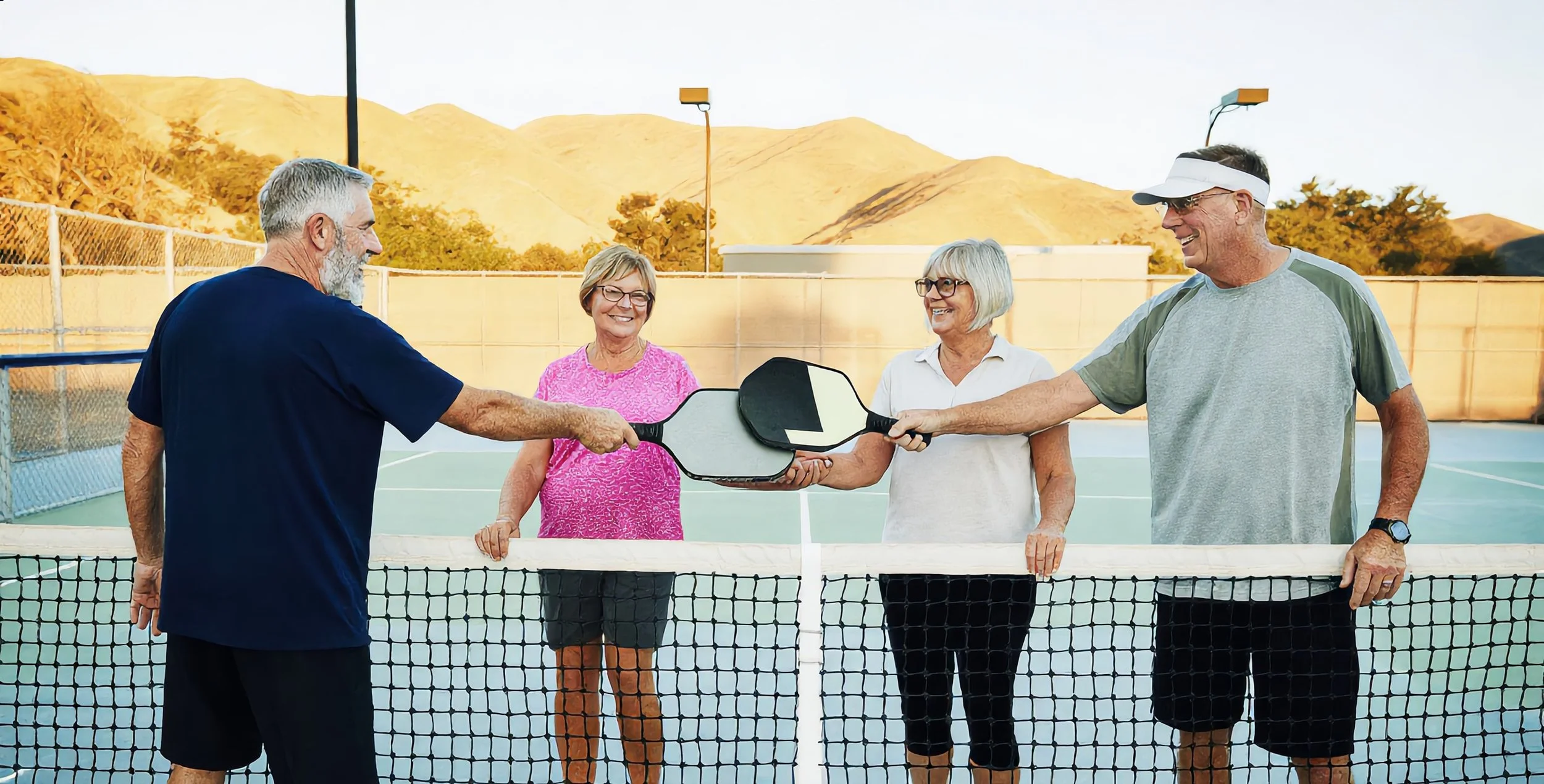
You started playing pickleball to move more and laugh more with friends a few mornings a week, not to end up explaining a wrist fracture to a surgeon. You’re in good company: Charles Barkley says his doctor friends call pickleball “the gift that keeps giving,” because so many players get hurt. Cedars-Sinai orthopedic surgeon Dr. Timothy Charlton has a rule of thumb: if a 65-year-old woman comes in with an acute pickleball injury, “it’s an Achilles rupture until proven otherwise.” Her first question is always when she can play again. “Pickleball is a drug,” he says, and if you’ve ever rearranged your week around open play, you know exactly what he means. The good news: almost every one of these injuries is preventable with the right warm-up and the right training. This guide is about keeping you in the game for the next 20 years.
How common are pickleball injuries after 50?
Short answer: common and rising fast. Most happen to players 60 and older, and most are preventable.
Pickleball injuries treated in U.S. emergency rooms rose 91% in two years, from about 8,900 in 2020 to nearly 17,000 in 2022, and hospital admissions more than tripled. Seventy-three percent of those patients were between 60 and 79.
Part of that is simple math: more people are playing, and the game draws an older crowd. Players will tell you something else too. Pickleball is sold as low impact, yet the stop-start lunging and side-to-side shuffling are hard on knees and shoulders, especially as you play at a higher level.
The #1 rule players learn the hard way: never backpedal
If you read only one section, read this one.
Ask around any court, or search the pickleball forums, and the same story keeps coming up: backpedaling for a lob, catching a heel and falling backward onto both hands, sometimes still gripping the paddle. The lesson players pass along is short. Never backpedal.
The research backs them up. Among players 60 and older, slips, trips and falls cause about 63% of pickleball injuries. Of pickleball fractures, 87% happen to players over 60 and 69% to women, and 92% of those fractures come from falls, most often a broken wrist or forearm. Bone density drops after menopause, which makes those falls more costly.
What to do instead: turn sideways and shuffle or cross over to get behind the ball, or let it go. Some clubs with players in their 70s and 80s have an unwritten rule that nobody lobs the older players, and nobody chases a lob. No point is worth a broken wrist.
What are the most common pickleball injuries?
Short answer: falls and wrist fractures, Achilles and calf injuries, knee sprains and tears, tennis elbow, shoulder injuries and, surprisingly, eye injuries.
The Achilles “pop.” The sudden sprint from the baseline to the kitchen for a drop shot is when calves tear and Achilles tendons snap. Players often describe it as feeling like someone kicked them in the back of the ankle. If you feel a pop, stop playing and get seen right away.
Knees. Most pickleball knee injuries are meniscus tears or MCL sprains from quick lateral moves. Long tournament days can also flare existing hip and knee arthritis.
Pickleball elbow and shoulders. Thousands of repeated swings irritate the tendons on the outside of the elbow. Heavy paddles, overuse and weak forearms and triceps are common causes along with technique. Shoulders take a beating too, and rotator cuff tears are a common reason older players end up in a surgeon’s office.
Eyes. A hard plastic ball at close range can do real damage, and at the kitchen line it can reach your face before you react. Clubs that take safety seriously encourage everyone to wear eye protection.
The pickleball mistakes that cause most injuries
Dinking for two minutes, then playing for three hours. The usual open-play warm-up is a minute or two of dinks before games that last all morning. Doctors point to long hours and skipped warm-ups as a big part of the injury spike.
Going from zero to five days a week. Enthusiasm is the most common cause of overuse injuries. If you’re new or coming back after a break, add playing time gradually, and leave a rest day between hard sessions. Your body does adapt: plenty of players who could manage three days a week at 63 are playing daily a few years later.
Playing in running shoes. Running shoes are built to move forward, not side to side, and players regularly blame them for rolled ankles and sore knees. Get court shoes that fit, chosen for support rather than to match the paddle.
Ignoring the walls, posts and fences. Many indoor courts are tight. Before you play a new court, notice how much room you have behind and beside you.
Most players don’t find out which of these apply to them until something gives out. A movement assessment catches it first — that’s where our pickleball training starts.
The 6-minute warm-up that actually works
Doctors recommend dynamic stretching, meaning stretches with movement, before you play. Do this before your first game:
- 1 minute of marching or easy jogging around the court
- 10 side shuffles each direction
- 10 leg swings forward and back, each leg
- 10 calf raises, slow on the way down
- 10 arm circles forward and back
- 10 shallow walking lunges
- Dinks, then drops, then drives, working gradually back to the baseline
A short bike ride or brisk walk to the courts counts too.
Train off the court so you can play on it
The players still on the court in their 80s tend to be the strong ones. Two short strength sessions a week focused on what pickleball demands will make you steadier, quicker and harder to injure:
- Step-ups onto a low box: protect against knee pain and weak lunges
- Side band walks: protect against knee sprains from lateral moves
- Slow calf raises: protect against calf tears and Achilles injuries
- Single-leg balance near a counter: protects against falls and rolled ankles
- Hip hinges or deadlifts: protect against hamstring pulls and back pain
- Wrist curls and triceps work: protect against pickleball elbow
- Band pull-aparts and rotations: protect the rotator cuff
- Practicing getting up off the floor: keeps a fall from becoming a crisis
Strength training also supports bone density, the best long-term protection against the wrist fractures that sideline so many women players. Our pickleball training is built around exactly this list.
When should you stop playing and see a doctor?
Stop and get checked if you notice:
- A pop in your calf, ankle or knee, especially with swelling
- Pain that changes the way you walk
- A wrist that’s painful, swollen or misshapen after a fall
- Any blow to the head, or a ball to the eye that affects your vision
- Elbow or shoulder pain that lasts more than a week or two
- Chest pain, unusual shortness of breath or dizziness: call 911. Among players 60 and older, about 11% of pickleball-related emergency visits are for heart problems and other non-injury events.
Keep playing, and play smarter
Pickleball keeps people moving, competing and laughing with friends, which is what aging well looks like. A good warm-up, two strength sessions a week and the discipline to let a lob go are what keep players on the court at 85 and out of the surgeon’s waiting room.
If you’re in the East Bay and want a program built around your game, our private pickleball training starts with a movement assessment and a plan to keep you playing.
This article is for general education and is not medical advice. Check with your doctor before starting a new exercise program, especially if you have a heart condition, osteoporosis or a recent injury.
Francisco is an ACE-certified personal trainer and the founder of The Fit Potato. He has coached clients of every age and ability for 23 years, including many pickleball players across Dublin and the East Bay. More about Francisco.
Sources
- Cheng et al., Arthroscopy, Sports Medicine, and Rehabilitation (2025): pickleball injuries and hospitalizations, 2020–2022
- Ghattas et al.: pickleball-related fractures in the U.S., 2002–2022
- Forrester, Injury Epidemiology (2021): senior pickleball and tennis injuries, 2010–2019
- Cedars-Sinai: the Achilles heel of pickleball
- Yahoo Sports: doctors warn ‘pickleball is a drug’
- OutKick: Charles Barkley on pickleball injuries